

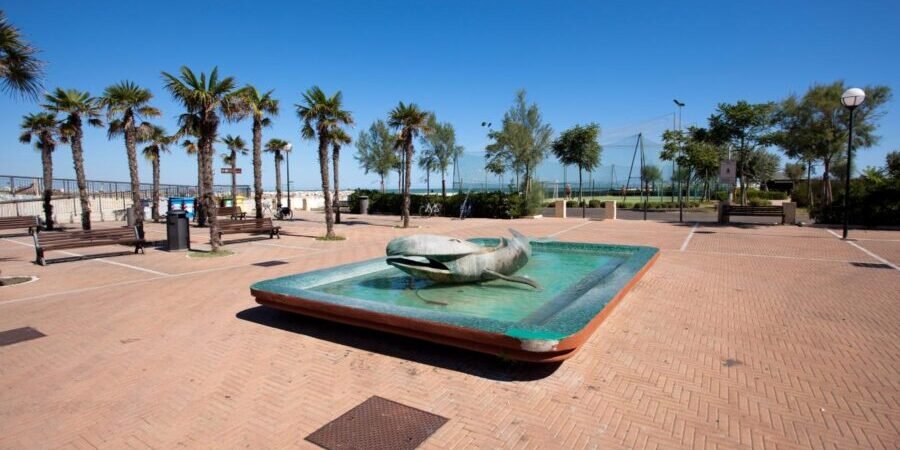
If you stroll through the village of San Giuliano a Mare, in Rimini, sooner or later you come across a small square overlooking the sea, with a whale-shaped fountain. It's Piazza della Balena, at Barafonda. It looks like just another little square — and yet it holds one of the stories most loved by the people of Rimini: that of the sperm whale of 1943, a work of art and a legend woven together.
A square born from a sea story
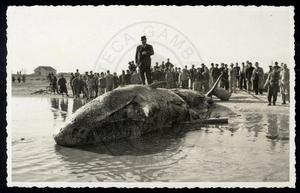
Piazza della Balena was created to commemorate one of the most astonishing events in Rimini's recent history. The 4 April 1943 a sperm whale of over twelve metres ran aground on Barafonda beach. For days the whole village rushed to see the “gentle giant”, and the story became part of the town's collective memory. Decades later, the Municipality of Rimini decided to pay tribute to that episode by dedicating a square to the cetacean.
Elio Morri's fountain, sculpted in 1969
The heart of the square is the whale-shaped fountain-sculpture, opera dello scultore riminese Elio Morri (1913-1992), one of the most important figures of twentieth-century Romagna art. The fountain was commissioned by the Municipality of Rimini and unveiled on 29 June 1969: from that day it has become one of the village's landmark places, loved by the children who play around it and by the tourists who photograph it in wonder.
Elio Morri was able to turn a historical event into an affectionate work of art: his whale is not frightening, it is not a sea monster. It's an almost playful image, almost a tender tribute to that creature which, for a few days in the spring of 1943, gave the town a story to be told forever.
The Rumours and Tales of the Village
Over the years, rumours and small folk rituals have blossomed around the Whale fountain. Some say that if you pass in front of the fountain and make a wish while touching the whale's tail, the wish comes true. Some tell that, on full-moon nights, the eldest of the village would go and sit on the bench in front of the fountain to talk to the whale, telling it the year's news.
The parents of San Giuliano bring their children here from a very young age, and everyone has a photo taken riding the whale. It's one of those “neighbourhood” traditions handed down without anyone ever having officially decreed them: they spring from the heart of the people.
The Mural, the Iron Whale and the Lungofiume dei Poeti
The sperm whale's story doesn't live in Elio Morri's fountain alone. At San Giuliano a Mare you can also admire a large mural dedicated to the sperm whale, a work by the artist Pavolucci, and in 2020 a new installation was unveiled in the square: a iron whale which Il Resto del Carlino called “one of the village's new symbols”. At the Lungofiume dei Poeti, in the heart of Rimini, the 1943 beaching of the sperm whale is one of the subjects told by the town's Museo Diffuso (open-air museum).
A walk worth taking at least once
If you come to Rimini, devote a morning to the village of San Giuliano a Mare. Start from the canal harbour, walk through the colourful fishermen's quarter, reach Barafonda and stop in Piazza della Balena: sit on the bench in front of Elio Morri's fountain, listen to the sound of the sea close by, and try to imagine that morning of 4 April 1943, when a giant of the sea chose this beach to make its appearance.
Curious to discover the sperm whale's full story? Read our article “The Rimini Sperm Whale of 1943”. Want to taste a liquid tribute to this story? Discover Gin Balena Pink, the craft gin from Rimini inspired by the very whale of Barafonda.